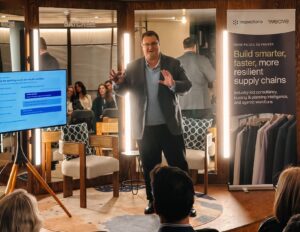
Most AI pilots in fashion and retail impress in a demo and then change nothing about how the work gets done. At an evening hosted by Weave and Inspectorio at Batch LDN in London on 8 October 2026, speakers and guests discussed what closes that gap: trusted data from the factory floor, AI that scales by workflow rather than by use case, and an operating model built for people and agents sharing the work.
Key takeaways
• Data comes first. Trusted supply chain data, built from the factory floor up, is the foundation for AI.
• Scale by workflow, not by use case. A portfolio of point agents still leaves people connecting the pieces.
• The operating model is most of the work. Decision rights, accountability and capability matter as much as the technology.
• Start with one workflow. Name its owner, agree the baseline, prove it, then connect more.
Why do AI pilots in fashion and retail stall?
AI pilots stall because proving a tool works is not the same as changing how the work gets done. A pilot can perform well in a demo and still leave untouched who does the work, who decides, and who answers when an agent gets it wrong.
That gap was the starting point for the evening, titled From Pilots to Proven: Turning Factory-Floor Data into Agentic Workflows, and for the open discussion that followed two short talks.
Why does data quality matter for agentic AI?
Agentic AI is only as reliable as the data it runs on. Katrina Duck, VP, EMEA at Inspectorio, showed how Inspectorio builds trusted data from the factory floor up. Quality, audit and factory data is what planning and costing agents run on, so that data has to be trustworthy before decisions are built on it.
What is an agentic workflow, and why does it scale better than a use case?
An agentic workflow is an end-to-end slice of work in which AI agents run the repeatable steps and people lead the judgement calls. Schalk de Klerk, Head of Strategic Growth and Partnerships at Weave, argued that AI scales by workflow, not by use case.
A portfolio of clever point agents still leaves a person connecting the pieces. A workflow with one trigger, one owner and one measured outcome is what the business actually feels.
How do you keep agentic AI safe?
Keeping agentic AI safe starts with decision rights: what an agent may decide alone, and inside which limits. Routine, reversible work inside an agreed tolerance can sit with the agent. Exceptions and anything that sets a precedent stay with a person.
That makes safety an operating model question as much as a technical one. Teams also have to settle who answers for a decision an agent made, and who trains, audits and retires the agents. Most of the effort sits there, not in the technology.