Insights
Weave Annual Event 2026: The Future of Supply Chain and the Impact of AI
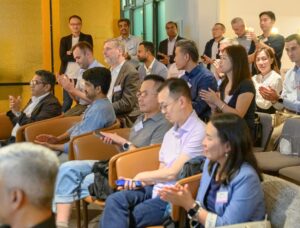
Weave convened sourcing and retail leaders in Hong Kong on 24 September for a session addressing a question few organisations have answered with precision: what enterprise AI actually requires to create value in supply chain operations, as distinct from what the market has promised.
The gap between promise and requirement
Andrew Keh, AI-Native Creative Technologist at Weave and Founder of Aisle8.ai, opened the keynote, “The Workforce That Never Arrived,” with a direct critique of prevailing AI narratives. The market has positioned AI as digital labour operating at software speed: capable of replacing entire functions, deployable within weeks, and generating immediate payback. In practice, few organisations experience this trajectory.
- Three requirements determine whether AI initiatives translate into operational value. First, workflows require redesign before deployment, since automation typically shifts the point of friction from task execution to review, decision rights, and handoffs between teams.
- Second, organisations need a functioning data backbone, meaning trusted data, defined business rules, clear permissions, and codified institutional knowledge, before layering AI on top.
- Third, returns materialise through iteration rather than launch. Value accrues via a learning loop that refines the workflow over successive cycles, not at the point of go live.
Andy illustrated the scale of this challenge with an internal benchmark. Individual productivity on bounded tasks has increased fiftyfold using AI tools. At the team level, spanning full end-to-end delivery, that multiple falls to three. The distance between those two figures represents the actual work of transformation, and it is where most organisations underestimate both effort and timeline.
He framed capability maturity as a four-stage progression: copilots that support individual task completion, functional agents that execute bounded jobs independently, orchestrated workflows that coordinate work across people and systems, and learning systems that retain context and improve performance over successive runs. Progress through these stages depends on the same underlying fundamentals: data integrity, governance rules, access permissions, institutional knowledge, and auditable evidence.
The session included a live demonstration built around scenarios sourcing leaders will recognise: a freight cost spike, a commodity price shock, an oil disruption originating from a geopolitical chokepoint. Rather than presenting the case conceptually, the demonstration showed the compression of time between signal detection and actionable decision, a compression that represents the core commercial case for AI adoption in sourcing.
Practitioner perspective: what changes and what does not
Deirdre Gleeson, Principal at Weave, moderated a panel featuring Laurent Madelaine, formerly Chief Product and Supply Chain Officer at Gymshark and previously at H&M, and Bart de Meirsman, Director at Different Dialogue and formerly of C&A. Where the keynote addressed capability requirements, the panel examined implementation reality.
Laurent argued for sourcing strategies built on supplier diversification rather than concentration, noting that the current tariff environment penalises single source dependency. He positioned AI’s contribution as velocity: the ability to model cross costing and lead time scenarios at a pace consistent with how quickly trade conditions now shift.
Bart challenged the framing of AI primarily as a cost reduction lever. Combined with practitioner experience, he argued, AI sharpens judgement and improves decision quality. Absent that experience, the same tools can accelerate poor decisions with equal efficiency, a caution worth weighing against the productivity narrative common in vendor conversations.
Both panellists converged on a point with direct relevance to supplier relationship management: improved data access does not substitute for supplier relationships, it strengthens them. Negotiating from real time data rather than a static quarterly scorecard shifts the dynamic from adversarial to collaborative, since both parties are working from a shared factual basis.
The panel was equally direct about the current limits of the technology. Crisis judgement, protection of proprietary design information from exposure through public AI tools, and assessment of individual team performance under pressure remain functions requiring human oversight. Neither panellist anticipated near term change to that boundary.
Implications for supply chain leaders
The evening’s central finding, consistent across both keynote and panel, is that AI’s constraint in supply chain contexts is rarely the technology itself. The binding constraint is organisational: data readiness, workflow design, and clarity on where human judgement remains irreplaceable.
For executives evaluating AI investment in sourcing and supply chain functions, three implications follow. Organisations should sequence data infrastructure ahead of automation ambition, resist evaluating AI initiatives solely on cost displacement metrics, and build governance structures that make explicit which decisions remain human owned as automation scales. Leaders who treat these as sequencing decisions, rather than simultaneous workstreams, are more likely to close the gap between the fiftyfold and threefold productivity figures cited above.
The evening closed with an extended networking session, during which conversations with Andy, Laurent, and Bart continued well beyond the formal programme. Several new working relationships originated in that informal setting rather than the structured agenda, reinforcing a theme of the evening itself: the most valuable exchanges in this transition are still fundamentally human ones.