In Conversation with Bill McRaith
The apparel industry, at its core, is a game of complexity. From tariffs and trade wars to late shipments and unpredictable consumer tastes, every season is a reminder that volatility is not an exception—it is the norm. Yet amidst those storms of daily disruption, certain leaders bring clarity. One of them is Bill McRaith, whose career arc uniquely spans both sides of the fashion supply chain—from running garment factories to shaping sourcing strategy at some of the world’s most recognisable retailers.
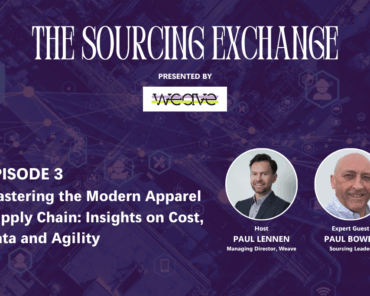
In this episode of The Sourcing Exchange, host Paul Lennen sits down with Bill to explore what really drives long-term supply chain success. McRaith’s career has included leadership roles at Victoria’s Secret, Walmart, and PVH, where he spent a decade as Chief Supply Chain Officer. Today, in retirement, he is pursuing audacious projects that reflect his conviction that the only path forward is rooted in deep partnerships, self-accountability, and an unwavering focus on long-term impact.
A Manufacturer Who Crossed the “Dark Side”
Bill often jokes about the two halves of his career. The first was as an old-fashioned manufacturer, the second as a senior retail executive.
“I built manufacturing from the ground up,” he recalls. Starting as a garment engineer in the UK, he moved in 1990 to China when the country was just opening up to global manufacturing. For nearly a decade, he lived on the factory floor—literally building plants from scratch, hiring graduates, and training workers. He launched operations not only in China but also across Central America and the Indian subcontinent.
Later, Bill crossed over into retail, or what he once described as “the dark side,” holding leadership roles at Walmart and Victoria’s Secret before joining PVH. The shift gave him a rare dual lens: he understood both the pain of manufacturers constantly squeezed on cost, and the urgent pressures of retailers trying to serve a fickle consumer.
That dual perspective shaped the philosophy that underpins much of his work today: manufacturers and retailers cannot succeed unless they confront challenges together.
“Look in the Mirror First”
When McRaith took his first retail supply chain role, he recalls a colleague approaching him on day one: “Now you’re here to sort out those manufacturers.”
His reply set the tone: “I’m not here to sort out the manufacturers. I’m here to sort out us.”
That mindset crystallised into a mantra he carried throughout his career: whenever something went wrong, the first place to look was in the mirror.
One vivid example: while at Victoria’s Secret, his team dug into recurring quality issues that the brand had traditionally put pressure on suppliers. When properly analysed, however, they found 96% of the problems were caused upstream in their own documentation and processes—inconsistent tech packs, miscommunications, or copy-pasted data errors from previous seasons.
Armed with that discovery, Bill eliminated chargebacks entirely. Under the old system, if a shipment had problems, the supplier was penalised financially, no matter the cause. This allowed retailers to avoid real accountability. By removing the practice, teams were forced to trace problems to the source and fix processes. Vendors, no longer needing to build “chargeback protection” into their margins, cut costs. More importantly, the focus shifted from blame to partnership. This case became proof of a principle that guided Bill’s career: real transformation begins by owning your own failures, not exporting them.
Rethinking Supplier Tiers
Partnerships—and the way companies define them—are the heart of Bill’s philosophy. He distinguishes among three supplier tiers:
• Tier 1: Strategic Partners – deeply embedded collaborators with global footprint, aligned objectives, and shared long-term vision.
• Tier 2: Core Partners – consistently reliable manufacturers, regional in capability, but not fully global or strategic.
• Tier 3: Transactional Partners – opportunistic relationships, often for a single product or category.
“Your Tier 1s,” he explains, “should represent roughly 40% to 50% of your business. These are the partners who help you think, innovate, and expand globally—not just make products.”
For Tier 1s, Bill developed bold new models:
Virtual Verticality
If a brand wanted speed, it needed a vertical supply chain in each region. Bill called this “virtual verticality”—ensuring that textiles, trims, and manufacturing were produced within the same geography to cut response times.
His early work in Sri Lanka created self-contained manufacturing ecosystems that were as fast as they were resilient. Later, in Ethiopia’s Hawassa Industrial Park, he insisted from the start that a textile mill be included. Sceptics said the region would be too challenging. Bill reminded them that when he first went to China, “there was nothing there either.”
The Mutual Profit Model
In another experiment, Bill abandoned per-unit price negotiations with one Tier 1 partner. Instead, they agreed to split profits across an entire category. If the brand sold well at full price, both profited. If markdowns reduced margin, both shared the loss. The arrangement encouraged innovation and fostered unprecedented trust, though ultimately it proved too early for the industry to embrace at scale.
Still, it was a glimpse of what real alignment could look like when partners transcend transactional mindsets.
The Danger of Short-Termism
The conversation inevitably turned to tariffs and political disruptions. For many in sourcing, the instinct is to scramble—move orders to a cheaper vendor, flee one geography for another.
Bill cautions against it. “The more you pull away from long-term partners for short-term wins, the more you lock yourself into forever being reactive,” he says.
He points out that the real growth markets for apparel are not in the US and Europe, which are flat or declining. The bigger opportunities lie in Asia, Africa, India, and other emerging economies. Brands that focus too tightly on defending current share in mature markets risk missing long-term growth elsewhere.
This makes the choice of partners critical. Tier 1 suppliers, with global footprints and strategic alignment, are best prepared to navigate expanding into new regions while absorbing the shocks of tariffs or sudden disruptions.
From Waste to Commodity: Bill’s Current Passions
In retirement, Bill has shifted his focus toward solving two of the industry’s most pressing problems: overproduction and end-of-life waste.
Project Interlace: Smarter Inventory Models
The first initiative, Project Interlace, proposes a hybrid sourcing model that brings a small slice of production closer to market. This proximate production acts as a testing ground and informs larger offshore orders.
The impact? By cutting overproduction—the second-largest source of waste in apparel—companies can boost profitability by as much as 150%. Just as importantly, they avoid relying on costly, carbon-intensive air freight to correct mistakes late in the selling season.
The Regeneration Zone: Transforming Textile Waste
Bill’s second venture is even more ambitious: creating the world’s largest regeneration zone in West Africa.
Today, a shocking amount of unsold or second-hand garment waste from the global North ends up in African markets, where much of it eventually piles up in uncontrolled landfills, rivers, and beaches. Instead of writing this off as an unfortunate externality, Bill envisions flipping the script: treating waste as a commodity.
His plan involves clustering recyclers, innovators, and manufacturers within a single hub, supported by common infrastructure, sortation, and logistics. Just as Silicon Valley thrives by congregating innovators, the regeneration zone would accelerate experimentation, reduce costs, and turn mountains of waste into feedstock for new products.
The benefits are enormous—environmental, economic, and financial. But adoption is slow. Retailers love the concept but hesitate to commit until the infrastructure is already built. This “wait-and-see” mentality, Bill warns, is one of the obstacles that keeps sustainability initiatives from scaling.
The Road Ahead: Integrating Profitability and Responsibility
One of Bill’s most striking observations is how to communicate change. Early in his advocacy, he led with sustainability arguments—carbon reduction, circularity, less waste. But executives tuned out.
Now, he leads with the financials: reduced cost, higher profit, risk mitigation. Only after this has captured attention does he bring in the sustainability story as “icing on the cake.”
“The reality,” he admits bluntly, “is nobody listens to sustainability alone anymore. But if you can show higher margins and faster turns, suddenly everyone leans in.”
For him, this is not greenwashing. It is reframing. Financial alignment is what compels action. And if that alignment yields massive sustainability gains, that is lasting impact.
Conclusion: A Call to Partnership and Vision
The apparel world will always be volatile. Tariffs will rise and fall. Politics will shift. Disruptions will come from new technologies, climate shocks, or consumer preferences. The difference between those who thrive and those who struggle lies not in reaction speed, but in the depth of their partnerships, the courage of their vision, and the willingness to confront their own flaws first.
Bill McRaith’s ongoing projects remind the industry that profitability and sustainability need not be opposing forces. When approached with courage and collaboration, they are one and the same.
As he puts it: “There is nothing you cannot do. The only question is whether you have the will—and the right partners—to do it.”